Have you ever experienced sudden heart palpitations, an unusually fast heartbeat or unexplained dizziness, but your ECG report appeared normal? Some heart rhythm abnormalities occur occasionally and may not be detected during a routine ECG test.
This is where Holter monitoring can help. It is a portable cardiac monitoring test that continuously records the heart’s electrical activity during everyday activities.
At Dr. Amit Bhushan Sharma’s Cardiology Practice, patients can explore comprehensive cardiac evaluation and diagnostic services to understand symptoms and identify possible heart rhythm abnormalities.
Let’s understand how Holter monitoring works, what it detects and when a cardiologist may recommend this test.
What Is Holter Monitoring?
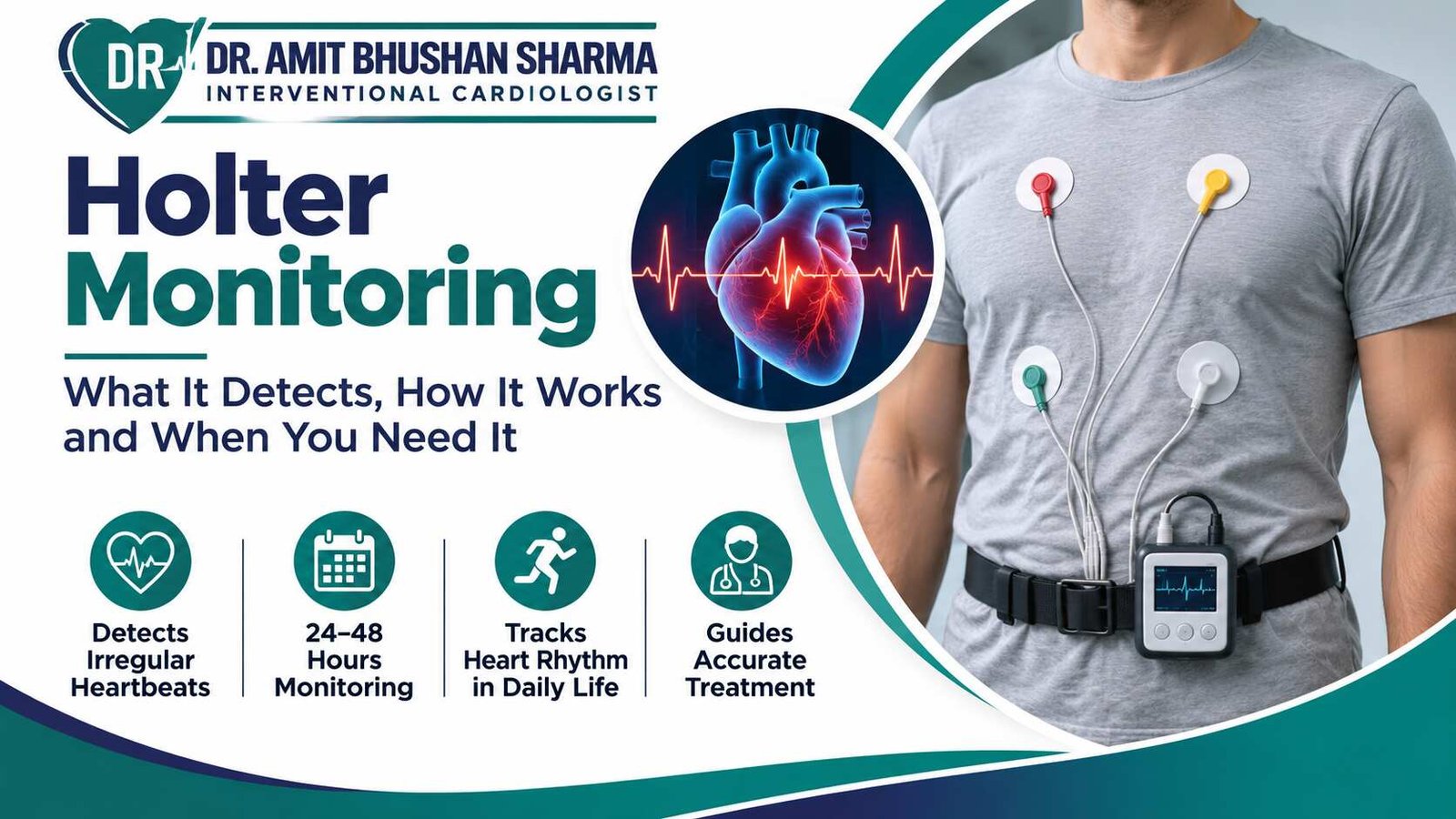
Holter monitoring is a non-invasive cardiac diagnostic test that records the heart’s electrical activity over an extended period, commonly 24–48 hours.
Unlike a standard ECG, which records the heart’s rhythm for a short duration, a Holter monitor continuously tracks heart activity while you perform your normal daily activities.
The device is small, portable and generally worn around the waist, attached to a belt or carried in a small pouch.
It uses electrodes attached to the chest to collect electrical signals generated by the heart.
The recorded information helps a cardiologist identify rhythm abnormalities that may not appear during a routine ECG.
Why Is Holter Monitoring Recommended?
A cardiologist may recommend Holter monitoring when a patient experiences symptoms that could be related to an abnormal heart rhythm.
Common reasons include:
- Repeated heart palpitations.
- Unexplained dizziness.
- Episodes of fainting or near-fainting.
- Unusually fast or slow heartbeat.
- Intermittent irregular heartbeats.
- Monitoring response to certain heart rhythm medications.
- Evaluation of selected patients with known rhythm disorders.
If symptoms occur occasionally, a standard ECG may not capture the abnormal rhythm. Longer monitoring can provide additional information.
What Heart Conditions Can a Holter Monitor Detect?
Holter monitoring can help identify different types of cardiac rhythm abnormalities.
1. Atrial Fibrillation
Atrial fibrillation (AFib) is an irregular heart rhythm that originates in the upper chambers of the heart.
It may cause:
- Irregular heartbeat.
- Palpitations.
- Fatigue.
- Shortness of breath.
- Dizziness.
Some people may not experience noticeable symptoms. Holter monitoring can help identify episodes occurring during the recording period.
2. Tachycardia
Tachycardia refers to a heart rate that is faster than expected for the circumstances.
Depending on the type, it may cause palpitations, dizziness, breathlessness or discomfort.
Holter monitoring can help record episodes and provide information about their frequency and duration.
3. Bradycardia
Bradycardia refers to an unusually slow heart rate.
In some individuals, it may be associated with:
- Fatigue.
- Dizziness.
- Weakness.
- Fainting.
- Reduced exercise tolerance.
Holter monitoring can help identify episodes of slow heart rhythm and pauses.
4. Premature Heartbeats
Premature beats are extra heartbeats that occur earlier than expected.
These may originate in the upper or lower chambers of the heart and are commonly described as skipped beats or heart flutters.
A Holter recording can help evaluate how frequently they occur.
5. Intermittent Rhythm Disturbances
Some abnormal heart rhythms occur only occasionally.
Continuous monitoring may help capture these episodes and provide information that a short ECG recording might miss.
A normal Holter result does not rule out every possible intermittent rhythm disorder, particularly when symptoms are infrequent.
How Does a Holter Monitor Work?
The Holter monitoring procedure is generally simple and painless.
Here is what happens during the test:
Step 1: Attaching the Electrodes
A healthcare professional attaches small adhesive electrodes to specific areas of your chest.
These electrodes detect the electrical signals generated by your heart.
Step 2: Connecting the Recording Device
The electrodes are connected to a portable recording device through small wires or an appropriate monitoring system.
The device continuously records your heart rhythm.
Step 3: Continuing Daily Activities
You can generally continue most of your normal daily activities while wearing the monitor.
The aim is to observe your heart’s rhythm during regular activities, rest and sleep.
Step 4: Recording Your Symptoms
You may be asked to maintain a diary of your activities and symptoms.
Record details such as:
- The time you experience palpitations.
- Episodes of dizziness.
- Chest discomfort.
- Breathlessness.
- Physical activity during symptoms.
This information helps the cardiologist compare your symptoms with the recorded heart rhythm.
Step 5: Returning the Monitor for Analysis
After the prescribed monitoring period, the device is returned to the healthcare team.
The recorded information is analysed and reviewed by the cardiologist to identify possible rhythm abnormalities.
Holter Monitoring vs Standard ECG: What Is the Difference?
Both ECG and Holter monitoring evaluate the electrical activity of the heart, but they serve different purposes.
| Feature | Standard ECG | Holter Monitoring |
|---|---|---|
| Recording duration | A few minutes | Commonly 24–48 hours |
| Monitoring | Short-term | Continuous |
| Device | ECG machine | Portable recorder |
| Main purpose | Assess heart rhythm at a particular time | Assess rhythm over daily activities |
| Best suited for | Detecting rhythm and other ECG abnormalities present during the test | Capturing intermittent rhythm disturbances |
A cardiologist decides which test is appropriate based on the patient’s symptoms and medical history.
How Should You Prepare for a Holter Monitoring Test?
Holter monitoring generally requires minimal preparation.
However, following a few instructions can help ensure accurate recordings.
1. Wear Comfortable Clothing
Choose loose-fitting clothes that allow the monitor and electrodes to remain in place comfortably.
2. Keep Your Skin Clean
Avoid applying excessive creams or oils to the chest before the test, as these may affect electrode adhesion.
3. Follow Device Instructions
The healthcare professional will explain how to wear and handle the recording device.
4. Maintain Your Normal Routine
Unless your doctor advises otherwise, continue your usual daily activities so the recording reflects your normal heart rhythm.
5. Maintain a Symptom Diary
Write down the time and nature of any symptoms you experience.
6. Inform Your Doctor About Medications
Share details of all medicines you take. Do not change or stop any medication unless instructed by your healthcare professional.
What Precautions Should You Take While Wearing a Holter Monitor?
A few precautions are important during the monitoring period:
- Keep the device dry unless you have been given instructions for a waterproof model.
- Avoid showering or swimming if the device is not waterproof.
- Do not remove electrodes without medical guidance.
- Avoid activities or equipment that your monitoring team has specifically advised against.
- Make sure the device remains securely attached.
- Contact the healthcare provider if an electrode becomes detached or the device stops working.
The specific instructions may vary depending on the monitoring equipment used.
What Happens After Holter Monitoring?
Once the recording period is complete, the device is returned for analysis.
The cardiologist reviews the recording to assess:
- Average heart rate.
- Highest and lowest recorded heart rates.
- Irregular heart rhythm episodes.
- Premature heartbeats.
- Pauses in heart rhythm.
- Correlation between symptoms and ECG changes.
Based on the findings, your cardiologist may recommend further investigations, medication adjustments or other treatment options.
A Holter monitor is a diagnostic tool, not a treatment by itself.
Is Holter Monitoring Safe?
Yes. Holter monitoring is generally a safe and non-invasive procedure.
It does not send electrical signals into the body and does not involve surgery.
Some people may experience minor skin irritation from the adhesive electrodes.
The device records your heart rhythm without causing pain and allows you to continue most routine activities.
When Should You Consult a Cardiologist?
Do not ignore recurring symptoms that may indicate a heart rhythm problem.
Consider seeking a cardiology evaluation if you experience:
- Frequent heart palpitations.
- Unexplained fainting.
- Repeated dizziness.
- Unusually fast or slow heartbeat.
- Breathlessness associated with palpitations.
- Intermittent irregular heartbeats.
Emergency warning: If you experience chest pain or pressure, severe breathlessness, fainting or other symptoms suggestive of a heart attack, seek emergency medical attention immediately. Do not wait for a Holter monitoring appointment.
Why Choose Dr. Amit Bhushan Sharma for Cardiac Evaluation?
Dr. Amit Bhushan Sharma is a senior interventional cardiologist and Director and Head of Cardiology at Paras Hospital, Gurugram.
His areas of expertise include interventional cardiology, cardiac diagnostics, heart rhythm disorders and advanced cardiovascular treatment.
Cardiac evaluation may involve tests such as:
- Electrocardiogram (ECG).
- 2D Echocardiography.
- Colour Doppler.
- Treadmill Test (TMT).
- Holter Monitoring.
- Blood pressure monitoring.
- Cardiac risk assessment.
Explore adult cardiac disease diagnosis and treatment to learn more about the available cardiac care options.
For more information about Dr. Amit Bhushan Sharma’s qualifications and cardiac expertise, visit his official cardiologist profile.
Frequently Asked Questions About Holter Monitoring
1. How long do I need to wear a Holter monitor?
A standard Holter monitor is commonly worn for 24–48 hours. The duration may vary depending on the suspected heart rhythm problem and the device prescribed.
2. Can I sleep while wearing a Holter monitor?
Yes. You are generally expected to wear the device while sleeping so that your heart rhythm can be recorded throughout the monitoring period.
3. Is Holter monitoring painful?
No. It is a non-invasive and painless test. Some people may experience mild skin irritation from the adhesive electrodes.
4. Can a Holter monitor detect an irregular heartbeat?
Yes. It can record several types of rhythm abnormalities, including atrial fibrillation, tachycardia, bradycardia and premature heartbeats, if they occur during the recording period.
5. Can I perform my normal activities during Holter monitoring?
In most cases, yes. You can generally continue your regular routine, but you must follow the device-specific instructions provided by your healthcare team.
6. Is Holter monitoring better than an ECG?
Neither test is universally better. A standard ECG provides a short recording, whereas Holter monitoring records heart activity over a longer period. The appropriate test depends on the symptoms and clinical situation.
7. What if my Holter monitor report is normal?
A normal report means that no significant abnormality was identified during the recorded period. If symptoms continue, your cardiologist may recommend additional monitoring or investigations.
Conclusion
Holter monitoring is an important diagnostic tool that helps cardiologists evaluate heart rhythm over an extended period. It can provide valuable information when symptoms such as palpitations, dizziness or unexplained fainting occur intermittently.
Unlike a standard ECG, continuous monitoring allows the healthcare team to assess heart rhythm during everyday activities and compare recorded changes with reported symptoms.
If you are experiencing recurring heart rhythm symptoms, consult a qualified cardiologist for an appropriate evaluation.